



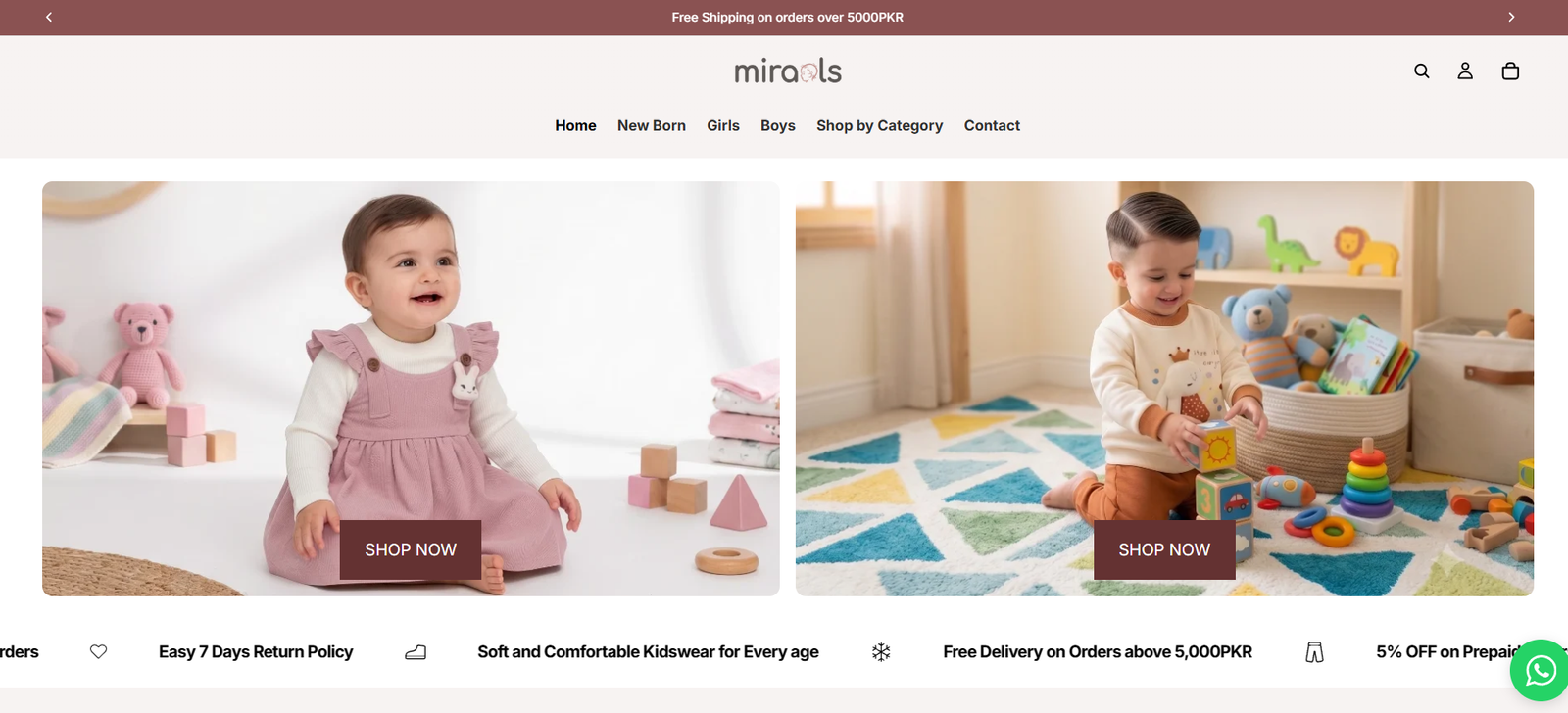
Every business has a first day. Ours started with my wife saying something simple over dinner: “I want to open a store for babies.” That was it. No business plan, no spreadsheet, just an idea she had been carrying in her head for a while.
Forty days later, Miraals had its first sale. A stranger, somewhere in Pakistan, trusted us enough to buy something for their child. That one small notification meant more to us than I can really explain in words.
This post is the honest story of those 40 days. I am writing it in simple words on purpose, because I want you to actually finish reading it, not just skim it and forget it in five minutes. And if you already run a business, stick around till the end — because the same steps we used to launch Miraals can help you launch or scale whatever you’re building too.
The Idea That Started It All
My wife has a law degree, not a business degree. But she understood something most people miss: she was a mother herself, buying clothes for our own daughter, and she kept noticing the same problem again and again. Everything available felt either too plain, too expensive, or just not made with love. She wanted something better. Something she would actually want to buy for our own child.
That’s also why we named the store after our daughter. It wasn’t a marketing decision. It was personal from day one, and I think that’s exactly why we didn’t want to rush it or get it wrong.
She had the idea. My job was to turn that idea into something real.
Week One: We Didn’t Even Open Shopify
Here’s a mistake I see a lot of new sellers make. They get excited, they open Shopify on day one, they upload a few products by evening, and by the next morning they are already asking why nobody is buying.
We did the opposite. For almost a full week, we didn’t touch the store builder at all. We just sat down and studied.
We looked at every boutique baby clothing brand already selling in Pakistan. What were they charging? How were they photographing their products? What kind of captions were they writing on Instagram? What were customers saying in the comments — the good reviews and, more importantly, the complaints?
Complaints are gold, by the way. Every complaint is basically a customer telling you exactly what to fix before you even launch.
We weren’t trying to copy anyone. We were trying to find the gap — the one thing every other store was doing wrong, or not doing at all, that we could build our whole brand around.
Finding the Right Suppliers, the Slow Way
Once we knew what kind of store we wanted, the next question was: who is actually going to make these clothes?
This part took patience. We didn’t just message the first supplier who replied fastest or quoted the lowest price. We compared cost sheets from different manufacturers, asked about minimum order quantities, checked how long production would actually take, and requested samples before committing to anyone.
I know it’s tempting to skip this step. You just want to get products online. But your profit margin gets decided right here, at the sourcing stage, not later when you’re setting prices on your website. If you rush this part, you feel the pain of it every single month after that.
I’ll be honest, I’m keeping the actual supplier names out of this post. That relationship is something we worked hard to build, and I’d rather protect it than publicize it.
Small Tests Before Spending Real Money
Once we had products coming in, we still didn’t jump straight into big advertising budgets. We ran small test campaigns on Meta first — small enough that if something failed, it wouldn’t hurt.
The goal of these tests wasn’t sales yet. It was information. Which products were people actually stopping to look at? Which photos got clicks and which ones got ignored? Which audience responded, and which one didn’t care at all?
We also made sure our tracking was set up properly from the very start. This part is boring to talk about, but it matters more than people think. If your tracking is wrong, you could spend a lot of money later and never really know what worked and what didn’t.
By the time we were ready to spend serious money on ads, we weren’t guessing anymore. We already knew.
Building a Crowd Before We Even Had a Store
At the same time all this was happening, I was doing something else quietly in the background: building an email list.
Not through paid ads. Not through some fancy tool. Just through people. Friends, family, people in their circles who were open to hearing about a new baby brand. It sounds small, almost too simple to matter, but it changed everything about launch day.
Because when we finally opened the store, we weren’t shouting into an empty room hoping someone would hear us. We were speaking to people who already knew who we were and were actually waiting to see what we had built.
If there’s one thing I’d tell any new business owner, it’s this: don’t wait until your store is live to start finding your first customers. Start collecting them before you even have anything to sell.
Turning an Idea Into an Actual Store
With the research done, the right suppliers picked, and a small crowd already waiting, it was finally time to build the actual store.
We didn’t want it to look like a generic Shopify theme with a logo slapped on top. We wanted it to feel like a real brand, with its own colors, its own fonts, its own personality. Something a parent would trust the moment the page loaded, even before reading a single word.
The catalog itself covered everything a parent might need: newborn wear, baby girl and baby boy collections, rompers, loungewear, little dresses for special occasions.
Now here’s a problem a lot of small brands face and never really solve: professional photography is expensive, and we didn’t have a big enough budget to shoot every single product in a proper studio. So instead of giving up on quality, I built my own workaround: a careful AI-based photography process that gave every single product page a clean, consistent, studio-quality look. Same lighting, same background, same feel across the whole store, so nothing looked out of place next to anything else.
We also didn’t want to depend only on ads and our own network forever, so we’d already started working on organic traffic as a longer-term play, in parallel with everything else. One blog post we published, Top Baby Stores in Pakistan, climbed into the top 3 search results for its target keyword. And the content we wrote directly into our Baby Girl Clothes collection page started pulling in visitors in less than a week of putting it up. Ads and personal networks get you your first sales. Content like this is what keeps bringing people in long after the launch buzz is gone.
It wasn’t the easy way. It was the resourceful way. And honestly, that’s most of what building a business actually is: solving problems with what you have, not waiting for the budget you wish you had.
If you want the more technical, step-by-step version of everything we built behind the scenes (the store setup, the photography workflow, the fixes along the way), I’ve written a separate case study covering all of it. I’ll drop the link here as soon as it’s live.
Day 40: The Moment Everything Was Worth It
After all of that — the research, the suppliers, the small tests, the quiet list-building, the store build — everything came down to one moment. Someone we had never met, somewhere we couldn’t even see, decided Miraals was worth their trust and their money.
That happened on day 40.
I won’t pretend it was some huge, dramatic moment with fireworks. It was actually quiet. A notification. A small number in a dashboard. But it meant everything, because it was proof — real proof, not a guess, not hope — that the idea my wife had one evening at dinner actually worked.
How the 40 Days Roughly Looked
I’m sharing this as a rough guide, not an exact diary. If you’re using this as a template for your own launch, adjust the numbers to fit your own situation.
- Days 1–7: Studying the market and the competition
- Days 8–15: Finding and vetting suppliers
- Days 16–28: Building the store, the brand, and the product catalog
- Days 20–30: Running small test campaigns on Meta (this overlapped with the store build)
- Days 29–37: Growing the email list and preparing for launch
- Days 38–40: Launch week, ending with our first sale
If You’re Already Running a Business, Here’s What This Story Really Means
Miraals is a new brand, but nothing about this process was really “new business only.” If you already run a store, a brand, or a service, and you’re planning to launch something new, enter a new market, or just want to launch better next time, the same five steps apply to you too:
- Research before you build anything. A week of honest research is much cheaper than a year of guessing why nothing is selling.
- Choose suppliers based on facts, not speed. Cost sheets, minimum orders, and lead times tell you the truth about your margins before you ever set a price.
- Test small before you spend big. A small, cheap test today can save you a large, expensive mistake tomorrow.
- Build your audience before you have traffic. Your first customers should already know your name before your website even goes live.
- Use creativity when your budget is small. A tight budget isn’t the end of quality. It just forces you to find a smarter way to get there.
None of these five steps need a big office, a big team, or a big budget. They just need to be done properly, in order, without skipping the boring parts because they feel slow. The boring parts are usually the ones that actually protect you later.
Miraals is live now at miraals.pk — come see what 40 honest days of work actually looks like. And if you’re building something of your own and want help with the store, the marketing, or both, that’s exactly what we do at Siffar.




0 Comments